Free PDF Software by Numbers: Low-Risk, High-Return Development, by Mark Denne, Jane Cleland-Huang
Spending the extra time by reviewing Software By Numbers: Low-Risk, High-Return Development, By Mark Denne, Jane Cleland-Huang can provide such fantastic experience even you are simply seating on your chair in the office or in your bed. It will not curse your time. This Software By Numbers: Low-Risk, High-Return Development, By Mark Denne, Jane Cleland-Huang will lead you to have more valuable time while taking remainder. It is quite delightful when at the twelve noon, with a mug of coffee or tea and also an e-book Software By Numbers: Low-Risk, High-Return Development, By Mark Denne, Jane Cleland-Huang in your device or computer system monitor. By enjoying the sights around, here you could start checking out.
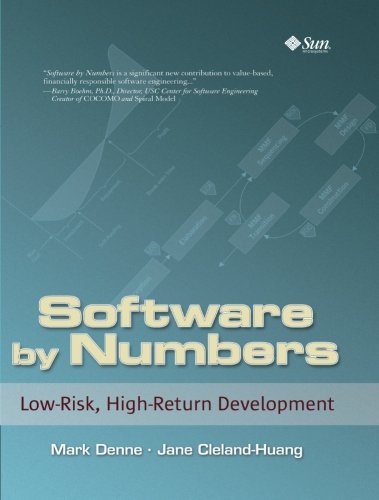
Software by Numbers: Low-Risk, High-Return Development, by Mark Denne, Jane Cleland-Huang

Free PDF Software by Numbers: Low-Risk, High-Return Development, by Mark Denne, Jane Cleland-Huang
Why ought to get ready for some days to obtain or get guide Software By Numbers: Low-Risk, High-Return Development, By Mark Denne, Jane Cleland-Huang that you buy? Why must you take it if you can get Software By Numbers: Low-Risk, High-Return Development, By Mark Denne, Jane Cleland-Huang the much faster one? You could discover the same book that you order right here. This is it the book Software By Numbers: Low-Risk, High-Return Development, By Mark Denne, Jane Cleland-Huang that you can receive directly after buying. This Software By Numbers: Low-Risk, High-Return Development, By Mark Denne, Jane Cleland-Huang is well known book around the world, of course lots of people will certainly attempt to have it. Why don't you come to be the first? Still puzzled with the method?
This book Software By Numbers: Low-Risk, High-Return Development, By Mark Denne, Jane Cleland-Huang is expected to be one of the very best vendor publication that will make you feel satisfied to purchase and also review it for completed. As recognized can typical, every book will have certain things that will certainly make an individual interested a lot. Also it originates from the writer, type, content, or even the publisher. However, many people likewise take the book Software By Numbers: Low-Risk, High-Return Development, By Mark Denne, Jane Cleland-Huang based on the style as well as title that make them astonished in. as well as right here, this Software By Numbers: Low-Risk, High-Return Development, By Mark Denne, Jane Cleland-Huang is really recommended for you considering that it has interesting title and also motif to review.
Are you really a fan of this Software By Numbers: Low-Risk, High-Return Development, By Mark Denne, Jane Cleland-Huang If that's so, why do not you take this book now? Be the initial individual that such as and also lead this book Software By Numbers: Low-Risk, High-Return Development, By Mark Denne, Jane Cleland-Huang, so you could get the factor and messages from this book. Don't bother to be confused where to obtain it. As the other, we discuss the connect to go to and download and install the soft file ebook Software By Numbers: Low-Risk, High-Return Development, By Mark Denne, Jane Cleland-Huang So, you might not lug the published publication Software By Numbers: Low-Risk, High-Return Development, By Mark Denne, Jane Cleland-Huang all over.
The presence of the on the internet publication or soft data of the Software By Numbers: Low-Risk, High-Return Development, By Mark Denne, Jane Cleland-Huang will relieve people to get the book. It will certainly also conserve more time to just look the title or writer or author to get up until your book Software By Numbers: Low-Risk, High-Return Development, By Mark Denne, Jane Cleland-Huang is revealed. After that, you can go to the link download to visit that is offered by this website. So, this will be an excellent time to start appreciating this publication Software By Numbers: Low-Risk, High-Return Development, By Mark Denne, Jane Cleland-Huang to check out. Consistently good time with publication Software By Numbers: Low-Risk, High-Return Development, By Mark Denne, Jane Cleland-Huang, constantly good time with cash to spend!
Denne, a business manager for a big software company, and Cleland-Huang apply ideas in application development methodologies to achieving financial rather than technological benefit.
- Sales Rank: #906874 in Books
- Published on: 2003-10-18
- Released on: 2003-10-08
- Original language: English
- Number of items: 1
- Dimensions: 9.00" h x .60" w x 6.80" l, .79 pounds
- Binding: Paperback
- 208 pages
From the Back Cover
Software by Numbers is a significant new contribution to value-based, financially responsible software engineering...—Barry Boehm, Ph.D., Director, USC Center for Software Engineering, Creator of COCOMO and Spiral Model
Link software development to value creation and optimize ROI.
Ultimately, software development is about creating value—yet, all too often, software fails to deliver the business value customers need. This book will help you change that, by linking software development directly to value creation. You'll learn exactly how to identify which features add value and which don't—and refocus your entire development process on delivering more value, more rapidly.
Software by Numbers shows you how to:
- Identify Minimum Marketable Features (MMFs)—the fundamental units of value in software development
- Accelerate value delivery by linking iterative development to iterative funding
- Optimize returns through incremental architecture techniques
- Effectively involve business stakeholders in the development process
- Sequence feature delivery based on "mini-ROI" assessments
- Quantify financial risk at every step throughout the development process
- Manage "intangibles" throughout the software development process
Whatever methodology you're already using—whether it's RUP or XP—this book shows how to achieve the goals that matter most to your business: reduced risk, better cash flow, and higher ROI.
About the Author
MARK DENNE is a Partner with consultancy firm Accenture, specializing in IT Transformation. He previously managed Sun Microsystems' Java Center in New York City leading architects working with financial services, media, and retail clients. He was Sun's chief architect for Citibank's financial services portal, voted the world's best online banking portal by Forbes and Yahoo! As head of software R&D for Computer Automation Europe, he invented the SABRE business-oriented 4GL.
DR. JANE CLELAND-HUANG is Assistant Professor at DePaul University's School of Computer Science, Telecommunications, and Information Systems, and Associate Director of DePaul's Institute for Software Engineering. Her research interests include process models, requirements engineering, and traceability. She currently teaches graduate and undergraduate courses at DePaul, supervises an active research program, and has published several papers in leading research journals.
Excerpt. � Reprinted by permission. All rights reserved.
Preface
"Absolutely! You must write the book!"
Such was the enthusiastic response of my manager, Stu Stern, Vice President of Sun Professional Services, to the idea of a book that would draw on the latest ideas in application development methodologies and apply them primarily for financial rather than technological benefit.
For all our efforts and successes in creating development methodologies, only a few practitioners have realized the potential for using these techniques to maximize financial return. And yet financial return is usually the enduring metric of success in software development, at least in the commercial world.
This book draws on several years of experience in winning competitive contracts for systems integration and application development projects. Although winning such deals is unquestionably about using innovation to outflank the competition, it's also about getting the money right. The price has to be within the customer's budget, the development cost has to be low enough for the bidder to make a good margin, and the margin has to be justified against the risk. There's nothing new in those ideas; they are true for any competitive procurement.
What is different about software development is that we're only just learning to understand value creation. The most common view is that software development incurs risks and costs. Despite this, even the most hardened, risk-averse development house would recognize that software carries implicit value. If that value were not there, no one would pay to have software developed. Unfortunately, all of the creative and business energies of the development organization are normally focused on reducing cost and risk. This is as true in the bid phase as in the implementation phase. The developer applies the latest software methodologies, institutes the latest project management strategies, and constantly evolves risk mitigation techniques, primarily to do just one thing: control cost.
Ironically, most of this activity is invisible to the customer, and the customer is rarely a part of the conversations that lead to the critical project decisions in these areas.
In the 1990s, I worked on a large competitive procurement for a Southeast Asian government. The nature of the project was such that differentiation through technical innovation was very limited because the evaluation parameters were just too tightly tied down. We needed a different way to win. It eventually occurred to me that if we optimized the time at which value was returned to the customer, instead of concentrating only on controlling risk and cost, we might be able to use that approach to present a uniquely differentiated value proposition. By reanalyzing and recategorizing the customer's requirements in terms of units of value, we found that we could indeed adjust the development sequence so that we delivered real value faster than if we'd optimized for total cost. At the same time we could amortize the cost into more manageable portions, each part of which had accountability for its returns.
The impact for the customer was dramatic. The approach was able to significantly reduce the borrowing line and interest payments, facilitate the earlier release of the product to market, and create a much cleaner modularity from a financial perspective.
The merchant banks needed to recompute the project finance numbers, the developers needed to understand why we were apparently reordering the customer's requirements, and the customers, of course, needed to see, understand, and compute for themselves the benefits of this approach. Very unusual conversations took place during this time. Developers became involved in conversations with bankers about return on investment. Project managers traded spreadsheets with financiers and investors. Analysts measured architectures in terms of "time to value" rather than functional efficiency. At the end of the process, instead of two presentations to the customer, one on the technology and one on the finances, we gave just one presentation covering both, with all sides of the team represented. We won the day, and the business!
Such was the genesis of incrementally funded software development, which later gave birth to the incremental funding methodology (IFM) outlined in this book. Naturally, the idea took many months to bring to fruition. The gestation of any idea is an unpredictable process. It's rarely clear exactly what will emerge until it does. Although the idea of incrementally funded software had shown some early signs of success, it needed to be more comprehensively proven. I was privileged to take over the management of Sun Microsystems' New York "Java Center" in late 1999. The Java Center is Sun's global Java Consultancy practice, and provides architecture and design expertise to customers creating solutions in Java and J2EE. It was quickly apparent that by writing the embryonic IFM concepts into proposals for application development work, we were able to capture and successfully deliver several very large engagements, particularly with finance industry clients. However we learned that incremental funding and the early release of value are critically dependent on the nature of the requirements and on their ability to be reconfigured for value optimization. Requirements engineering is a discipline in itself, and I was fortunate to know an expert in this field.
My co-author is Jane Cleland-Huang, assistant professor of Computer Science at DePaul University in Chicago. I first met Jane when we were both 16 and growing up in England. We had a common interest in supporting aid organizations for the Third World and met at a 24-hour sponsored "starve-in" in the small town of Wimborne Minster in Dorset, England. At that time I had just learned to write Fortran IV programs on punched cards and run them through the batch terminal at the local technical college after school. Jane's interest in programming developed later when she began working for an international relief organization. In the meantime, we went to the same church, had several friends in common, and began a lifelong friendship that survived university, relief work assignments in different countries, and, eventually, Jane's departure to live in Chicago. Some time later while I was living and working in San Francisco, I flew to Chicago and invited Jane to meet me at the O'Hare Airport Hilton to propose that we write this book together. To my great delight, she agreed. Her background and experience are pivotal to this book in every sense.
Most helpful customer reviews
2 of 2 people found the following review helpful.
Easy to understand low-risk, high-return development work, but not exactly "paint by number"
By Erik Gfesser
This book caught my attention because I was searching for a decent book on ROI and software development, and Dr. Jane Cleland-Huang was a professor at the graduate school I attended (I was never a student of hers and have never met her). Furthering my interest in "Software by Numbers" were the facts that it runs less than 200 pages and is from Sun Microsystems. In my opinion, most large technology works can be significantly shortened if the fluff is removed from them (who has time to read fluff?), and I view Sun as a respected firm that is involved with a lot of the technologies in my workplace. Maximizing financial return during the development of software is the main subject of this book, and the attempt of Jane and Mark Denne, her co-author, to show how to do so is a good one. Interestingly enough, the Preface of this text discusses how the authors arrived at the title "Software by Numbers", and although this title is better than the others that their friends and colleagues suggested, because it is a bit too similar to the common expression "paint by number" (which can be an idiomatic expression for "easy" or "mindless"), I do not think it does the book content justice. ROI is anything but a simple subject. Multiple formulas exist for ROI to begin with, and return can be a subjective matter because it can involve a lot of assumptions. Quite a few financial tables are presented with the book material, and a cursory review of the accompanying ROI examples shows that there is a bit of explanation missing. Of course, there is a tradeoff here between conciseness and thoroughness, and explaining all of the assumptions made would probably not be appropriate for most readers. The authors start the discussion by stating that software development is a very difficult endeavor. The following portions of the introductory chapters explain well much of the language used throughout the rest of the book, such as minimum marketable feature (MMF) and return on investment (ROI). The authors then compare MMF-based ROI with classic ROI and discuss how to discover MMFs, how to determine their value, and how this all fits with incremental funding methodology (IFM). While there exists overlap between the architecture discussion and the content of "Architecture in Practice" (see my review for that text), the authors quickly move forward to discussing the delivery of valued features to customers and how parallel development of multiple MMFs is often well suited for meeting customer needs. Although the chapter on how to manage intangibles provides a much more simple explanation than books such as "Making Technology Investments - ROI Road Map to Better Business Cases", the authors get their point across in a succinct manner. Similarly, the authors discuss how IFM can thrive when used with the (Rational) Unified Process and other more agile software engineering methodologies.
2 of 2 people found the following review helpful.
Excellent description of cost-benefit based project-planning
By C. J. Reynolds
This book was a surprise but only because I didn't read the title properly.
"Software by Numbers : Low-Risk High-Return Development".
Fundamentally, it is about project planning and prioritisation and not about estimation.
This book starts with three assumptions:-
1. You are using a feature-driven development iterative release approach to a project.
2. You can attach numeric business value to each of the features.
3. You can estimate the cost of developing the required software modules to implement the above features.
With these assumptions in place, the authors then use a number of net present value accounting algorithms to help you schedule the software module development to provide "Low-Risk High-Return development".
The algorithms are designed to maximise business return and minimise the risk as per the book's title.
It is only 190-pages, well-laid out with clear examples pitched at the right level for me so I swallowed in a week-end with only faint and distant grumbling from my wife.
I will be trying it out on my next green-field project and interested to see how assumptions 2 and 3 stand up to the test.
Highly Recommended.
1 of 1 people found the following review helpful.
Worth reading, nice analysis on incremental delivery
By Bas Vodde
Software by Numbers focuses on the financial aspects of software development. It introduces a method called "Incremental Funding Method" which demonstrates how software development with incremental delivery can fund itself, therefore lowering investment costs and thus lowering the risks for starting the development. The key-idea in the method is probably to break up the feature sets of a software product in MMFs (minimum marketable features) and calculate the investment and ROI of these separately and then deciding in what order they could be developed to maximize the total ROI.
The ideas of software by numbers are important to understand when selecting a development method that enables incremental delivery (like most agile development methods). Its especially good in convincing people who do not know software development that incremental delivery is a very good idea and financially sound idea.
To me this book was definitively worth reading. However, at some points the book seemed to lose my attention. At points I felt the authors were just repeating the same points over and over again. Eventhough the book is not very thick, I felt it could have been even thinner and conveying the same message.
Still, it's a recommended read.
See all 17 customer reviews...
Software by Numbers: Low-Risk, High-Return Development, by Mark Denne, Jane Cleland-Huang PDF
Software by Numbers: Low-Risk, High-Return Development, by Mark Denne, Jane Cleland-Huang EPub
Software by Numbers: Low-Risk, High-Return Development, by Mark Denne, Jane Cleland-Huang Doc
Software by Numbers: Low-Risk, High-Return Development, by Mark Denne, Jane Cleland-Huang iBooks
Software by Numbers: Low-Risk, High-Return Development, by Mark Denne, Jane Cleland-Huang rtf
Software by Numbers: Low-Risk, High-Return Development, by Mark Denne, Jane Cleland-Huang Mobipocket
Software by Numbers: Low-Risk, High-Return Development, by Mark Denne, Jane Cleland-Huang Kindle
Software by Numbers: Low-Risk, High-Return Development, by Mark Denne, Jane Cleland-Huang PDF
Software by Numbers: Low-Risk, High-Return Development, by Mark Denne, Jane Cleland-Huang PDF
Software by Numbers: Low-Risk, High-Return Development, by Mark Denne, Jane Cleland-Huang PDF
Software by Numbers: Low-Risk, High-Return Development, by Mark Denne, Jane Cleland-Huang PDF


